In this part of the series, we will look at the core of our portfolio: value stocks. At Privatinvestor we are first and foremost focused on value stocks. These are stocks that we believe represent businesses that are underpriced relative to their future earning potential. In short, we want to buy high-quality companies at a bargain. If economic and market conditions were less turbulent than they are today, this would be our sole focus.
The great thing about investing in value stocks is that they are a natural component of any crisis portfolio. When building a crisis portfolio, it is unwise to try to predict the future precisely. No mortal can do this. Instead, we should focus on building robustness into our portfolio. Building a crisis portfolio is like designing safety equipment for a passenger vehicle: we cannot predict whether the car will ever crash or the complex physical dynamics that result from the crash, so instead we try to build in safety features – seatbelts, airbags etc – that will be robust under any scenario.
If we want to carry on the analogy, we might say that value stocks are like the reinforced components – high-strength metals, composites etc – that are built into the bodies of modern cars to allow them to absorb as much crash energy as possible. Just as vehicle designers focus on these “safety features”, value investors talk about the “margin of safety” that is built into value stocks. The concept here is quite simple to understand. Value stocks are stocks that analysts believe are worth more than they are currently trading for. Value investors say that the “fair value” of the stock is higher than the current price. Investors who focus on growth stocks, by contrast, try to predict the future growth of a company and pay far more for the stock than the underlying business fundamentals justify.
The margin of safety means that there is much less chance of value investors being disappointed than growth investors. If there is a crash in the overall market, financing for growth companies will quickly dry up, and growth investors will be faced with the reality that their rosy expectations were not realistic. Meanwhile, value investors will have much less reason to be disappointed. Value stocks are always already cheap. They have very pessimistic forecasts of the underlying business’ future. So, they have much less far to fall. Let us look at an historical example: the Dotcom bubble – a bubble that is very similar to the AI bubble of today. In the chart below we show three assets: the Russell 1000 Value Index, the Russell 1000 Growth Index, and Cisco which was an extremely fashionable stock during that bubble.
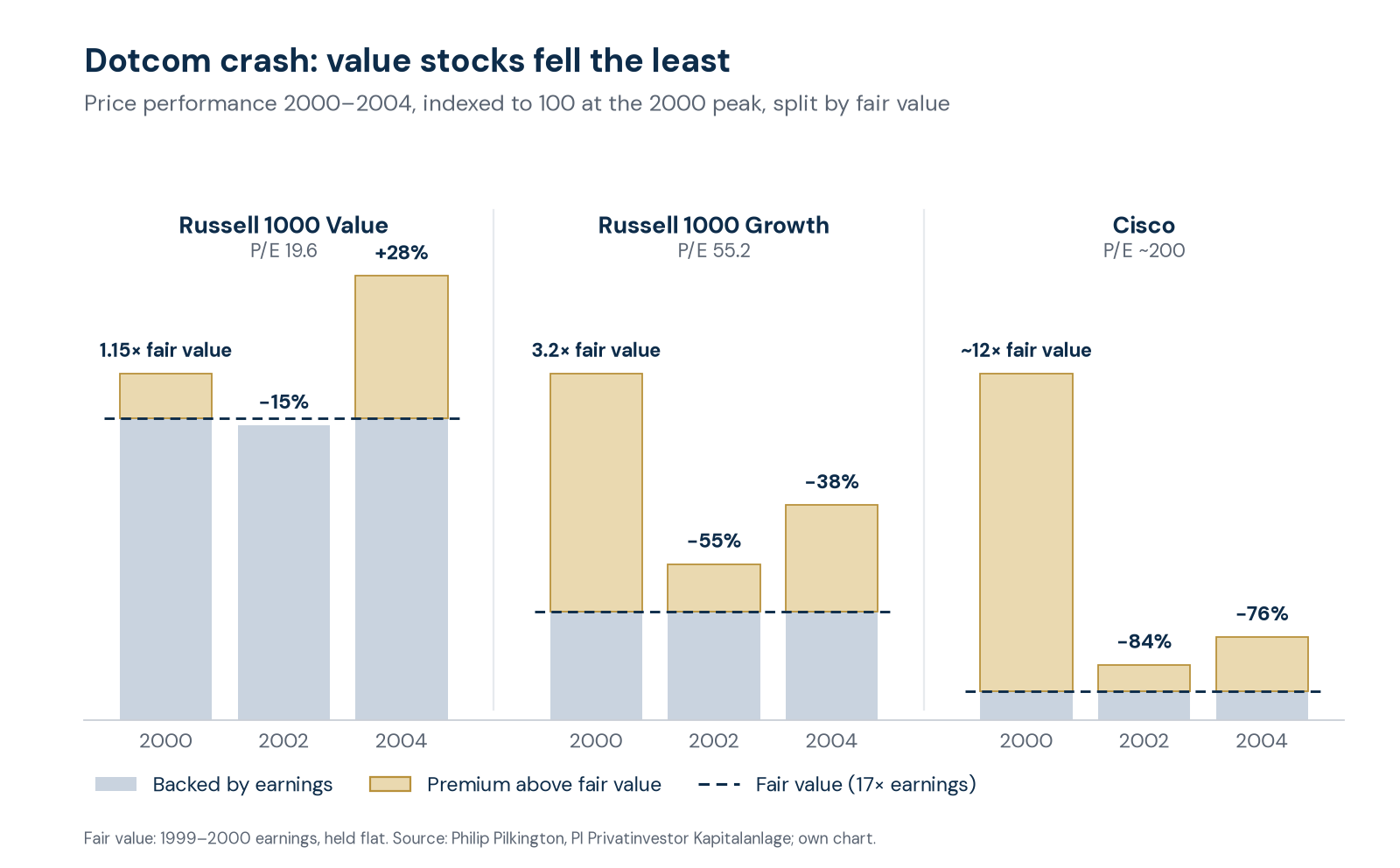
Here we see the dynamics perfectly. The value stocks only fell by around 15% while the growth stocks fell by 55%. Very fashionable names like Cisco fell 84%. Then there is the recovery. Investors in the value index saw positive returns after four years, while investors in growth stocks were still down 38%. Cisco investors who were chasing the fashionable names of the day were down a crushing 76% after four years. The explanation for this is shown in the chart: the value component.
The Dotcom bubble was so extreme that even the overall value index was trading over fair value. This was a brutal time for value investors who had a hard time finding value stocks anywhere. Nevertheless, the value index was trading much more modestly above fair value than growth stocks and fashionable names. The value index was trading around 15% above fair value – which perfectly predicted its subsequent fall. Meanwhile, the growth index was trading 3.2 times its fair value and fashionable Cisco was trading an incredible 12 times its fair value. Fair value metrics explain why those hiding out in value stocks – even slightly overvalued value stocks – fared better than people chasing growth in the overall market.
In the Max Otte Multiple Opportunities (MOMO) portfolio, we have tried our best to select stocks that we believe trade at an actual discount from the overall index. We believe this will cushion the part of our portfolio devoted to stocks against any overall market crash. This raises the question: why hold stocks at all; why not just sell our stocks and wait for the crash? This comes back to the impossibility of predicting the future. At Privatinvestor we know what we do not know. We think that there is strong evidence that we are currently in the final phases of a stock market bubble, but we can never be 100% sure. If we fully sell out of stocks and the market continues to climb for another one, two or even four years, we will show poor returns for our investors. Our strategy is instead to find values with a strong margin of safety that will protect them from a market shock and offset these losses with assets that we believe will perform well in a crisis scenario. It is to these assets that we will turn in the subsequent parts of our series.
This article is the fourth in a series on our overall portfolio strategy. Previous articles can be found here: Part 1, Part 2, Part 3.