

A Crisis Builds in US Treasury Markets
US Treasury yields are spiralling out of control. The 30 year Treasury yield now stands at just over 5.25%, significantly higher than around 4.8% when Trump took office. As the chart below shows, long-dated Treasury yields are approaching highs last seen in June 2007 – just before the housing bubble started to burst which would lead to the Global Financial Crisis of 2008.

The US Treasury is acting increasingly desperate in the face of these rising interest rates as they put pressure on the US government’s ability to borrow. The interventions began in mid-August when US Treasury Secretary Scott Bessent announced a $2 billion buyback of Treasury debt and followed this up a few days later by saying he would double the buyback amount. Investors in US Treasuries ignored the intervention. Yields continued to climb, rising by two basis points after the election. Bessent tried again earlier this week, announcing a $6 billion buyback. This time the investors did not just ignore Bessent, instead the intervention led to them actively dumping Treasuries and yields went even higher. Unless something changes, the US Treasury seems to be losing control over interest rates on US government debt.
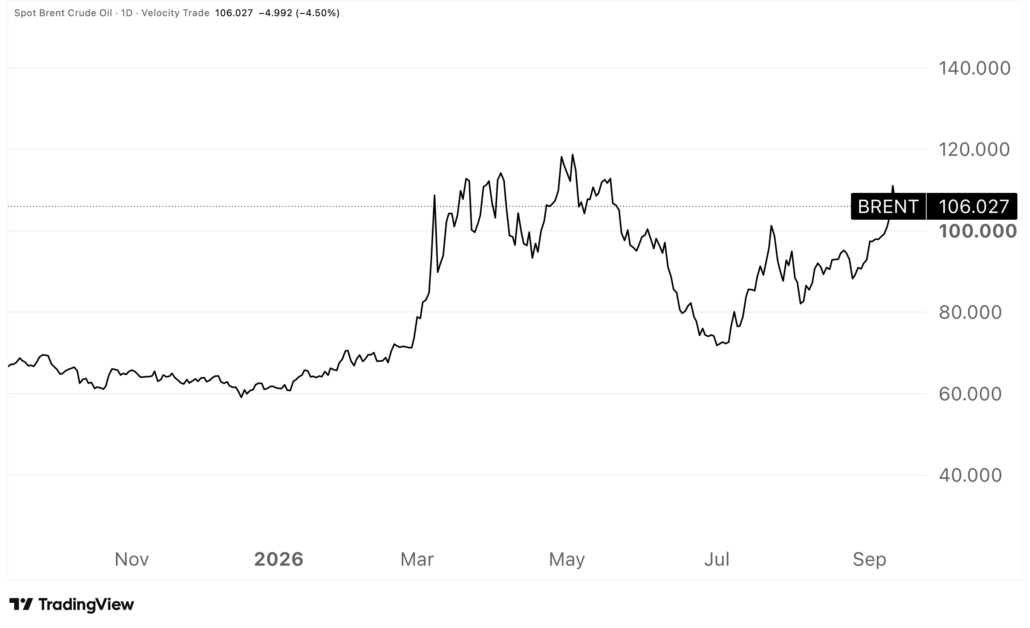
At the same time as Treasury yields spiral out of control, oil prices have once again crossed $100 a barrel. As the chart shows, this is not quite as high as the $115 oil futures hit in May. But it is far higher than the low of $72 a barrel we saw at the beginning of July.
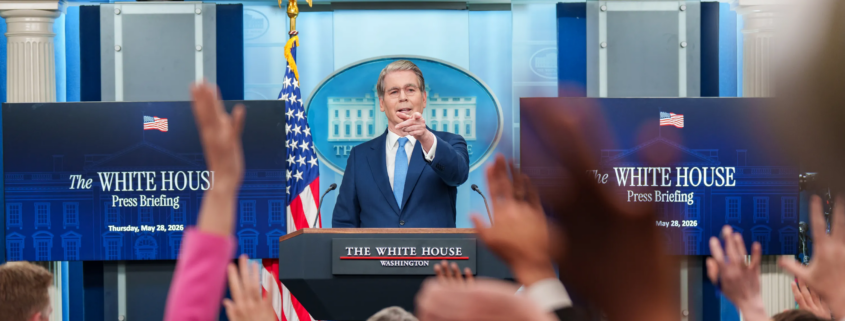
The Trump administration has been trying every trick available to keep oil prices suppressed as the crisis in the Strait of Hormuz puts pressure on global energy supplies. Some of these are public, like the release of millions of barrels of oil every week from the government’s Strategic Petroleum Reserve. Others are secret, with many speculating that the government is signalling to hedge funds to short the market. For most of the summer, the US government seemed to have the upper hand and was able to push the price of oil futures down – even as the price of refined products like gasoline, diesel, and jet fuels continued to rise. Now it appears that the Trump administration has lost control over the oil futures price. Previous interventions indicated that the Treasury wanted oil trading between $75 and $90. When oil broke through $90 in the first week of September a confused Scott Bessent gave a press conference where he admitted that he did not understand why oil prices were still rising. At the same time as the Trump administration has lost control over the oil price it has lost control over the interest rates on US government debt too.
All this is building toward a major crisis. Rising oil prices will soon start to feed into consumer prices, which will lead to rising inflation. Rising inflation will lead to even higher interest rates on US government debt. Meanwhile, the Federal Reserve is indicating that they will raise interest rates. At some point, inflation and rising interest rates will lead to problems in the real economy. American AI stocks are probably in a bubble. In the summer of 2026, the tech-heavy NASDAQ has a cyclically adjusted PE ratio of over 60, around 33% higher than at the end of 2023. Investments in data centres and semiconductor manufacturing currently account for around 70% of real investment growth in the American economy. A popping of the AI bubble could lead to a recession.
The Max Otte Multiple Opportunity Fund (MOMO) is well-placed to deal with this set of circumstances. MOMO is currently overweight energy and refining stocks. As the US government loses control over oil futures prices, we expect these stocks to rise in value. MOMO is also overweight precious metals. In recent days, as the Treasury loses control over interest rates, nervous investors are piling into precious metals and prices are rising. Since the start of August gold has risen around 10% and silver has risen around 17.5%. MOMO has also built up cash reserves that can be deployed if market valuations start to come down. The remaining stocks in the portfolio have been chosen because they are cheap. This means that if there is a market event, these stocks should temporarily decline in value significantly less than the overall market. The equity component of the portfolio is well-positioned to take advantage of any decline in valuations that we see moving forward.
About the author

Philip Pilkington is an economist and investment strategist. He is the author of The Reformation in Economics, The Collapse of Global Liberalism and the co-author of the forthcoming Bust: The Economics of Demographic Decline. Mr Pilkington has written on economic and financial issues for a variety of leading media publications including The Daily Telegraph, The Spectator, The New York Post and many others.
He holds the role of Chief Strategist at Privatinvestor Capital.
Disclaimer
The information provided is for informational purposes only and does not constitute an offer to buy, sell or subscribe to securities. It represents neither an offer, a solicitation of an offer, nor an invitation to buy, sell or subscribe to any financial instrument, nor does it constitute a recommendation or investment advice.
Purchases of the fund may only be made in accordance with, and on the basis of, the sales prospectus (including the management regulations), the simplified sales prospectus and the key investor information document, as well as on the basis of the fund’s semi-annual and annual reports. These documents are available on the relevant fund pages online (www.max-otte.fonds.de).
Past performance and historical data are not a guarantee, nor a reliable indicator, of future returns or performance. It is possible that the distribution of the units, or of certain unit classes, may be terminated in your country.
For further information, including information on your rights as an investor, please visit www.max-otte-fonds.de. This website also contains information on sustainability aspects.

Folgen Sie unseren Kanälen: