


Rising Yields and Food Prices: Are We Heading Toward Stagflation?
In some ways it seems that the Trump administration and the media that follows its guidance when it comes to media coverage just seems stuck in the past. Most people reading the news will have been focused on whether the Strait of Hormuz has returned to normal or not. That is a far more difficult question than some commentators would have us believe.
While this is an important issue, another one of equal or greater important demands our attention as investors: the meltdown in global bond markets. The current yield on American 10-year government debt is 5.2% up from 4.3% in March this year. The British government’s 10-year borrowing rate has risen from 4.9% in March to 5.4% while Japan’s has risen from 2.4% to 2.9%.
Mostly, this meltdown is caused by rising inflation expectations. These are in turn generated by the rising energy prices – and even potential energy shortages –caused by the closure of the Strait of Hormuz and the destruction of refinery and storage capacity by war and terrorism.
At this stage the inflation caused by the disruption is already baked in. We can see this by looking at a chart that has US 10-year Treasury bond yields plotted against the oil futures price. Before September the two series moved together. But since the beginning of September, they have moved in opposite directions. By now it is an open secret that the US Treasury is doing everything in its power to get oil futures prices down. No one knows exactly how they are doing this, but a big component appears to be by generating optimistic stories about the global oil market and feeding these narratives to pliable journalists.
The rationale for doing this was no doubt to keep US Treasury bond yields down and bond prices up to ensure that the costs of borrowing for the highly indebted US government does not spiral out of control. This week we saw another intervention in the US Treasury market. After the inflation numbers came in above expectations on Wednesday the US 10-year yield shot up from 5.2% to 5.3% but then, for no discernible reason, it reversed and fell back below the level before the release of the inflation numbers. There is a wealth of evidence that the US Treasury is using every means available to them to try to keep American borrowing rates from spiralling into crisis territory.
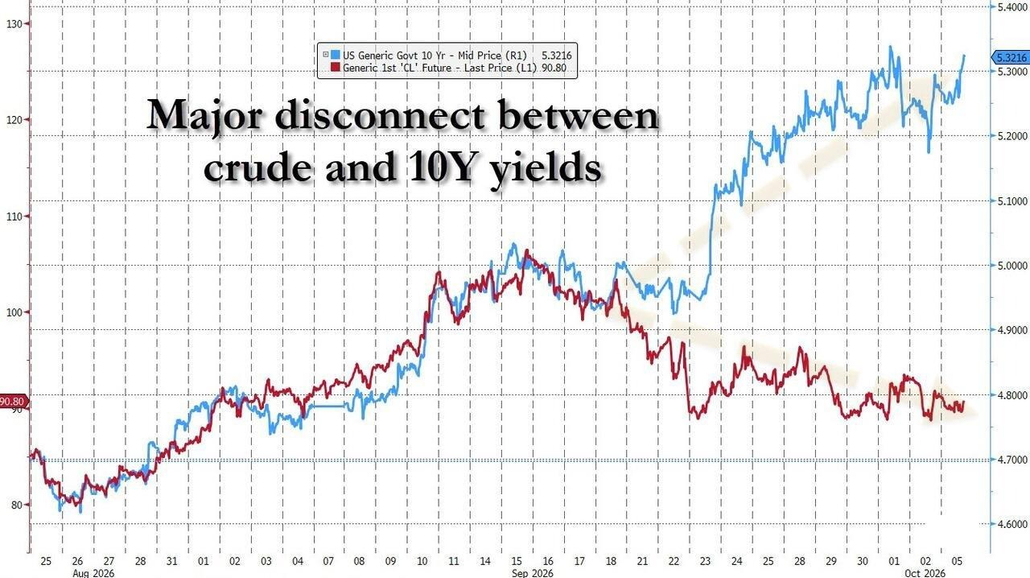
The divergence between the 10-year Treasury bond yield and the oil futures price should thus be read as an indication that the US Treasurys power to influence economic fundamentals is shrinking, if not imploding.
We are already seeing the beginnings of inflation in the early survey data. Data from Bloomberg shows food inflation already soaring in global markets for food staples. (one specific number earlier on in the intro would give it more punch) From the end of 2025 to early October 2026, wheat rose roughly 35–38% and sugar about 39–43%, the largest moves. Soybeans were up around 21–23%, while corn lagged with a gain of about 13–15%. These are significant increases caused by the shortage of fertiliser due to the inability to move fertiliser through the Strait of Hormuz. Early survey data also show this inflation starting to come through into the general economy. US ISM price indices rose in September: manufacturing prices jumped 6.8 points to 77.9, and services prices rose 1.4 points to 74.0. This is the data that central banks across the world are watching as they contemplate raising interest rates.
There is a chance that we are entering a period of ‘stagflation’ – there is both inflation and a recession or economic stagnation. Usually, inflation falls when there is a recession. This means that although the incomes of consumers fall, they can at least be confident that prices are not rising too much. In a stagflation, incomes fall and prices rise. This is extremely painful for consumers.
It is the main reason that we are currently invested in stocks like The Kroger Co and Dollar Store General that will benefit from this shift. These are mid-range grocery stores that consumers who usually frequent more expensive stores turn to when economic times are tough. Our portfolios also contain energy stocks and precious metals that seek to stabilise returns if hard times hit.
About the author

Philip Pilkington is an economist and investment strategist. He is the author of The Reformation in Economics, The Collapse of Global Liberalism and the co-author of the forthcoming Bust: The Economics of Demographic Decline. Mr Pilkington has written on economic and financial issues for a variety of leading media publications including The Daily Telegraph, The Spectator, The New York Post and many others.
He holds the role of Chief Strategist at Privatinvestor Capital.
Disclaimer
The information provided is for informational purposes only and does not constitute an offer to buy, sell or subscribe to securities. It represents neither an offer, a solicitation of an offer, nor an invitation to buy, sell or subscribe to any financial instrument, nor does it constitute a recommendation or investment advice.
Purchases of the fund may only be made in accordance with, and on the basis of, the sales prospectus (including the management regulations), the simplified sales prospectus and the key investor information document, as well as on the basis of the fund’s semi-annual and annual reports. These documents are available on the relevant fund pages online (www.max-otte.fonds.de).
Past performance and historical data are not a guarantee, nor a reliable indicator, of future returns or performance. It is possible that the distribution of the units, or of certain unit classes, may be terminated in your country.
For further information, including information on your rights as an investor, please visit www.max-otte-fonds.de. This website also contains information on sustainability aspects.


Folgen Sie unseren Kanälen: