


Crisis portfolio: Stocks that perform well during both inflation and recession
If you are a regular portfolio manager in the investment business, the state of the world right now is your worst nightmare. No one is sure what comes next. Value investors like us do not have to worry as much. As value investors, we largely ignore the market cycle and buy the stocks of solid businesses.
Nevertheless, very radical changes in the investing environment can impact even a value portfolio. To offset this risk, a good strategy is to find a category of stock that will perform well in either and inflation or a recession environment. But to fit in a value portfolio, this stock would also have to be a solid company that is currently selling for cheap. Finding a stock like this is challenging but not impossible.
Let’s go back to first principles. For example, let’s ask what impact does economic turmoil have on consumer behaviour.
- Inflation erodes peoples’ ability to spend and consume. As prices rise, consumers must tighten their belts to make sure that they can stay within their budget.
- Recession, on the other hand, results in layoffs and less wage growth. Through a different channel, it also results in consumers trying to spend less.
- The type of business that does well in this environment is a company that sells consumers essentials – items people cannot do without – at a cheaper price than their competitors. Consumers will turn to cheaper shopping options in a crisis to control their more limited budget. The ideal type of business is one that is mid-ranged that can absorb business from high-end luxury businesses in the same sector.
We have decided to focus on the ultimate consumer essential: groceries. When crisis hits and peoples’ budgets tighten, consumers that shop at high-end grocery stores will switch to mid-range grocery stores to control their costs. We are looking at a few companies in this sector but currently our favourite is The Kroger Co.
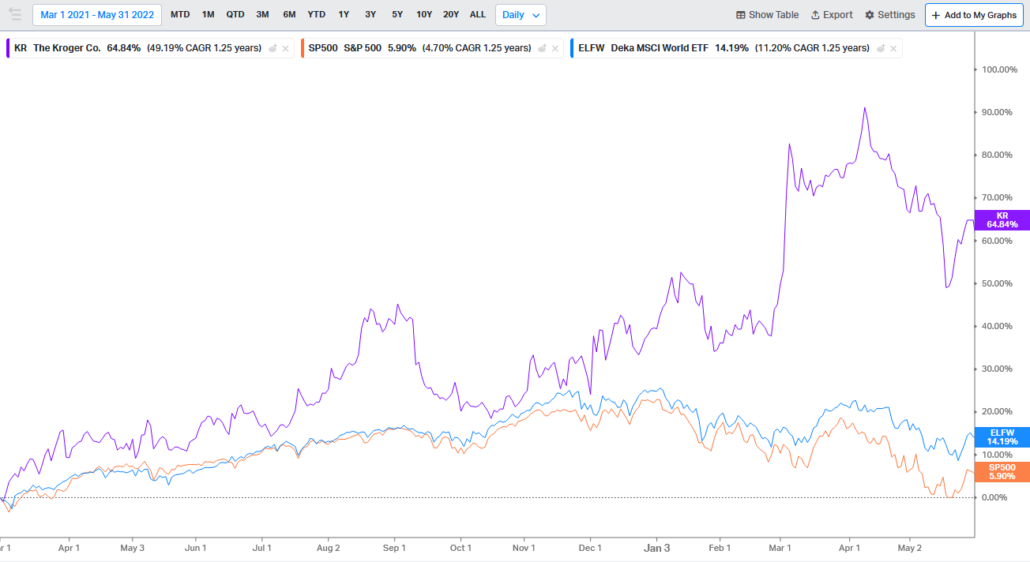
The Kroger Co. is one of America’s largest grocery retailers, operating about 2,700 supermarkets and multi-department stores across 35 states under banners such as Kroger, Ralphs, and Fred Meyer. It also runs pharmacies and fuel centres, makes private-label foods, and offers pickup and delivery. It is a mid-range grocer that during times of economic turmoil can compete with premium competitors like Whole Foods for cash-strapped consumers. The following chart shows the performance of The Kroger Co. during the last bout of inflation between March 2021 and June 2022. As we can see, the stock returned 64.8% on its investment compared to the S&P500 which returned 5.9% in the period and the MSCI World index which returned 14.2%. Note the sharp run-up in the stock price in March 2022 after the Russian invasion of Ukraine: The Kroger Co. is a company that feeds on turmoil.
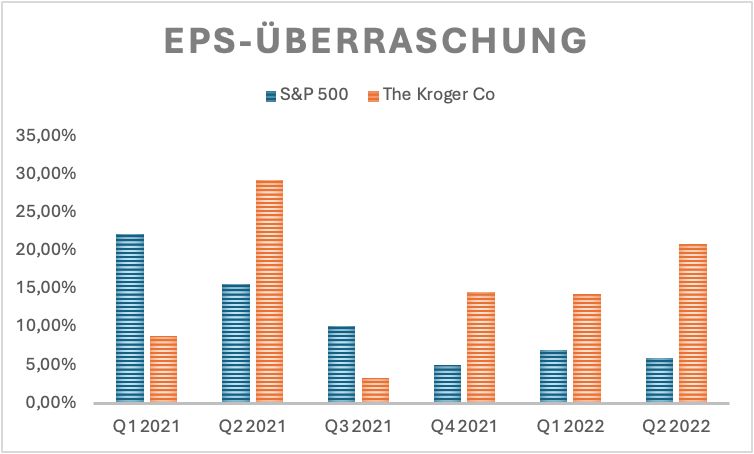
The drivers of returns in this period were not just psychological, they were real. The following chart shows Kroger’s EPS Surprise relative to the overall S&P500’s EPS Surprise. EPS Surprise measures the actual earnings-per-share that the company reports versus analyst forecasts of earnings-per-share growth. A positive EPS Surprise means that the firm has beat expectations in that period; a negative reading signals the opposite. As we can see, Kroger had consistently high Earnings Surprises throughout this period. Almost every quarter during the previous inflation crisis Kroger announced earnings that beat analyst expectations by a large amount. This is why the stock rose in value so much. Driving these high earnings were shoppers that switched from more expensive brands like Whole Foods to Kroger stores to save money.
In the Max Otte Multiple Opportunity Fund (MOMO) we currently hold just under 10% of the portfolio in stocks like Kroger that we believe fit into a value portfolio purely on their merits but also provide the portfolio with protection in the case that there is economic turmoil. We think of companies like this as value stocks that come with the added bonus of a free insurance policy – and we can never say “no” to a free insurance policy.
About the author

Philip Pilkington is an economist and investment strategist. He is the author of The Reformation in Economics, The Collapse of Global Liberalism and the co-author of the forthcoming Bust: The Economics of Demographic Decline. Mr Pilkington has written on economic and financial issues for a variety of leading media publications including The Daily Telegraph, The Spectator, The New York Post and many others.
He holds the role of Chief Strategist at Privatinvestor Capital.
Disclaimer
The information provided is for informational purposes only and does not constitute an offer to buy, sell or subscribe to securities. It represents neither an offer, a solicitation of an offer, nor an invitation to buy, sell or subscribe to any financial instrument, nor does it constitute a recommendation or investment advice.
Purchases of the fund may only be made in accordance with, and on the basis of, the sales prospectus (including the management regulations), the simplified sales prospectus and the key investor information document, as well as on the basis of the fund’s semi-annual and annual reports. These documents are available on the relevant fund pages online (www.max-otte.fonds.de).
Past performance and historical data are not a guarantee, nor a reliable indicator, of future returns or performance. It is possible that the distribution of the units, or of certain unit classes, may be terminated in your country.
For further information, including information on your rights as an investor, please visit www.max-otte-fonds.de. This website also contains information on sustainability aspects.


Folgen Sie unseren Kanälen: