


Investing Amidst Chaos: Part 2 – The Problem
Today, responsible investors face a very difficult task. Just as in 1999–2000 and 2007, we face a market that is showing clear signs of being in a bubble. But unlike in either of those periods we also face global chaos, possible energy shortages and an emerging war economy. This set of circumstances makes it difficult even for those who are experienced at investing during bubbles because the bubble dynamics that we are used to may not play out in the same way as they did before.
To understand this, we can turn to a famous chart based on the data created and regularly updated by Nobel Prize-winning economist Robert Shiller. The gold line shows the interest rates at which the American government can borrow. The dark blue line shows the cyclically adjusted price-to-earnings ratio or the CAPE. The CAPE tells us the price of the overall stock market relative to the earnings of the companies that make up the stock market. A high CAPE means that investors are paying an awful lot of money for a relatively low amount of earnings. In other words: a high CAPE means that the stock market is overvalued.
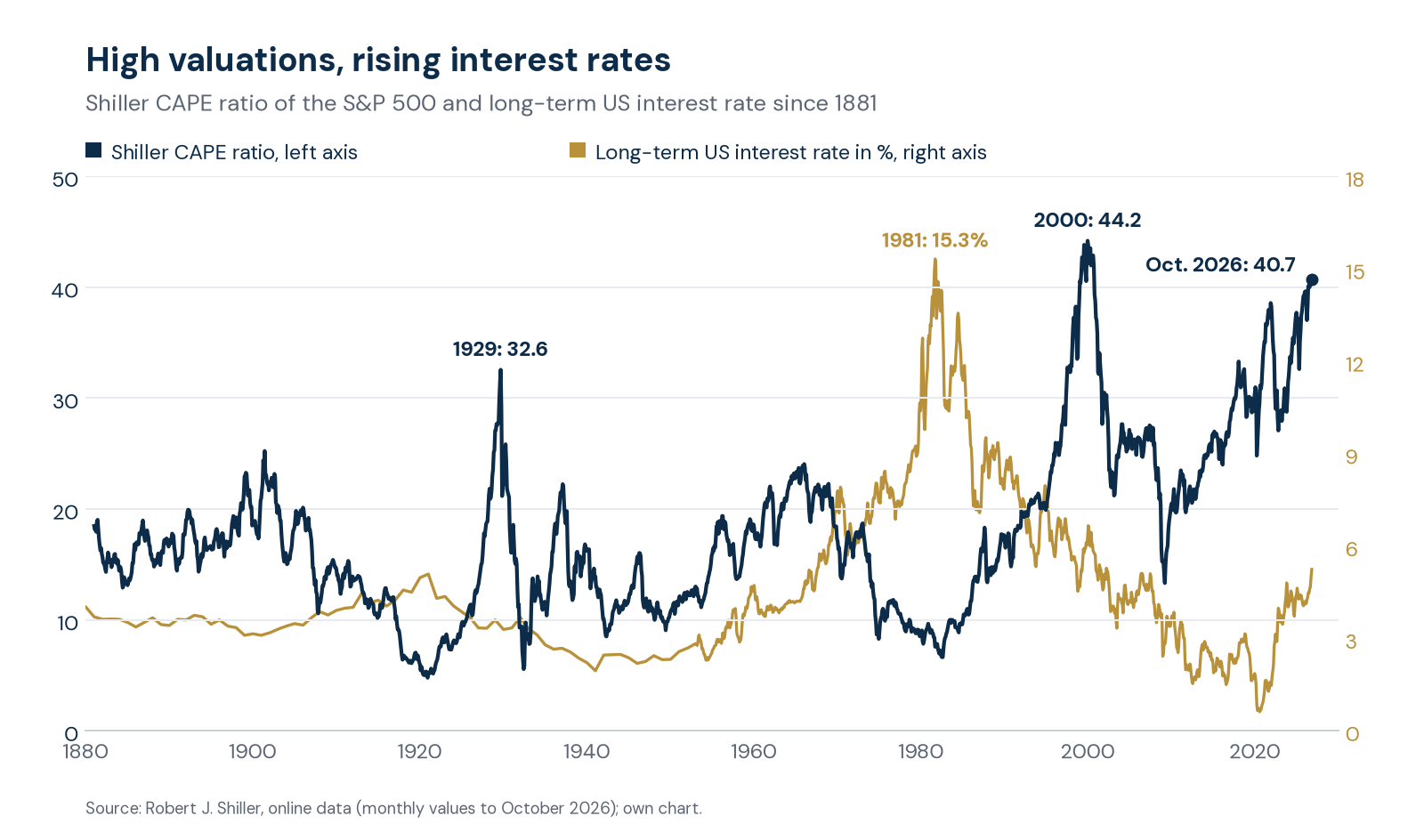
In the chart we see clearly that on the CAPE measure the stock market today is very overvalued. It is currently trading at a higher multiple (40.7x) than just before the 1929 stock market crash (32.6x). The only time that we have seen a higher multiple than today was at the peak of the 1999–2000 Dotcom bubble when the market traded at a 44.2x multiple. For value investors this means that overall, we should not be holding as much money in stocks as we normally would.
The problem, however, is that it is not clear where else we should put that money. Look at the gold line in the chart again. In 1999–2000 and in 2007 long-term interest rates were reliably coming down year after year. This was due to the low inflation environment and was representative of a 40-year bull market in bonds. In this environment, when the CAPE showed a high reading, value investors could hold money in bonds. If the stock market crashed, the bond positions would rise in value and stabilise the value investor’s portfolio. But as we can see from the chart, since 2020 long-term interest rates have been rising. This is representative of the fact that bond markets have entered a structural bear market. This is because of rising inflationary pressures that we have experienced since the global chaos started in 2020.
This creates a problem for the responsible investor: we fear that we are experiencing a serious financial market bubble, but we cannot use bonds to stabilise our portfolio against this shock. What should we do? This is what we have been putting a lot of thought into at PI Privatinvestor Kapitalanlage over the past few months. We have come to some conclusions about how to balance a portfolio in this environment. Over the coming weeks we will explore this question in detail and explain to our investors how we are implementing it in our portfolios.
The primary goal in the current environment is the preservation of capital. When markets are this overstretched and the world is this chaotic, a good investment outcome is simply one in which we do not lose money. This will leave us well-placed to deploy capital when valuations come down. In the next few weeks, we will examine in detail how we aim to do this so our investors can better understand how we are protecting their money. We think that, in 2026, we have built one of the most robust portfolios in the world.
This article is the second in a series on our overall portfolio strategy. The previous article can be found here: Part 1.
About the author

Philip Pilkington is an economist and investment strategist. He is the author of The Reformation in Economics, The Collapse of Global Liberalism and the co-author of the forthcoming Bust: The Economics of Demographic Decline. Mr Pilkington has written on economic and financial issues for a variety of leading media publications including The Daily Telegraph, The Spectator, The New York Post and many others.
He holds the role of Chief Strategist at Privatinvestor Capital.
Disclaimer
The information provided is for informational purposes only and does not constitute an offer to buy, sell or subscribe to securities. It represents neither an offer, a solicitation of an offer, nor an invitation to buy, sell or subscribe to any financial instrument, nor does it constitute a recommendation or investment advice.
Purchases of the fund may only be made in accordance with, and on the basis of, the sales prospectus (including the management regulations), the simplified sales prospectus and the key investor information document, as well as on the basis of the fund’s semi-annual and annual reports. These documents are available on the relevant fund pages online (www.max-otte-fonds.de).
Past performance and historical data are not a guarantee, nor a reliable indicator, of future returns or performance. It is possible that the distribution of the units, or of certain unit classes, may be terminated in your country.
For further information, including information on your rights as an investor, please visit www.max-otte-fonds.de. This website also contains information on sustainability aspects.


Folgen Sie unseren Kanälen: