


Navigating the Coming Storm of Fed Rate Hikes
The Federal Reserve finally raised interest rates. Though widely discussed and anticipated, but this should not diminish the importance of the move.
The decision to raise rates was unanimous – none of the 12 Federal Open Market Committee (FOMC) board members voted against the hike. This in itself is unusual. Also Federal Reserve Chairman Kevin Warsh communicated the hike in such a way that left the door wide open for future hikes. We can only conclude that the Federal Reserve are preparing for a severe bout of inflation.
It is hard to communicate just how much sentiment has shifted in financial markets in the past two weeks.
Between May and the end of August everything seemed calm. Then, in the last two weeks, inflation expectations exploded. Why is this? Since the Hormuz crisis started earlier this year, the US government has been trying every trick in the box to keep markets calm and oil futures prices down. At a certain point though the illusions run out and reality starts to hit. It seems that we have now reached that point. The following chart shows the bets that market participants were putting on rate hikes since Warsh got the job.
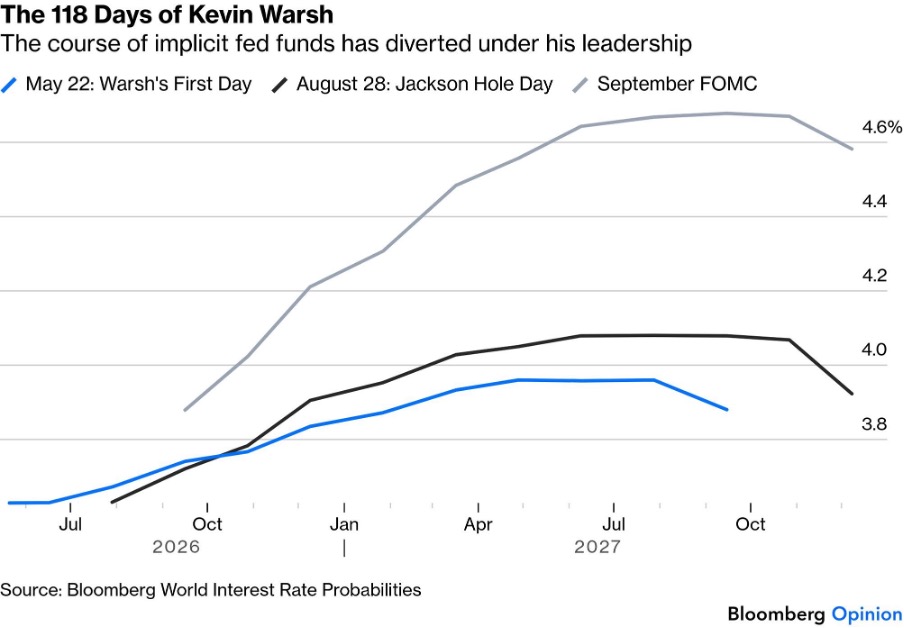
What comes next? US government borrowing costs are already under massive pressure due to the chaos in the Middle East. The raise in the Federal Reserve interest rate will aggravate this. The interest rate on a 10-year government bond has crossed 5% which is generally seen as being difficult to sustain. I would not be surprised if it climbed to 6% in the coming weeks as the market prices in serious fuel shortages and more hikes by the Federal Reserve. At a certain point, this will cause a crisis likely in either the mortgage market, the private equity and private credit markets, the stock market or all three.
As noted in last week’s note the Max Otte Multiple Opportunity Fund (MOMO) is well-placed to deal with this set of circumstances. The portfolio is structured to deal with either inflation or a recession – or both. Currently its main defensive investments are its overweight positions in energy stocks and its large holding of precious metals. But we are currently building positions in retail stocks that we believe are both good investments on a value basis and will benefit from any major inflationary or recessionary developments. If a storm is on the horizon, it is often best for ships to find a port. Our intention is for MOMO to provide a port to wait out the coming storm.
About the author

Philip Pilkington is an economist and investment strategist. He is the author of The Reformation in Economics, The Collapse of Global Liberalism and the co-author of the forthcoming Bust: The Economics of Demographic Decline. Mr Pilkington has written on economic and financial issues for a variety of leading media publications including The Daily Telegraph, The Spectator, The New York Post and many others.
He holds the role of Chief Strategist at Privatinvestor Capital.
Disclaimer
The information provided is for informational purposes only and does not constitute an offer to buy, sell or subscribe to securities. It represents neither an offer, a solicitation of an offer, nor an invitation to buy, sell or subscribe to any financial instrument, nor does it constitute a recommendation or investment advice.
Purchases of the fund may only be made in accordance with, and on the basis of, the sales prospectus (including the management regulations), the simplified sales prospectus and the key investor information document, as well as on the basis of the fund’s semi-annual and annual reports. These documents are available on the relevant fund pages online (www.max-otte.fonds.de).
Past performance and historical data are not a guarantee, nor a reliable indicator, of future returns or performance. It is possible that the distribution of the units, or of certain unit classes, may be terminated in your country.
For further information, including information on your rights as an investor, please visit www.max-otte-fonds.de. This website also contains information on sustainability aspects.


Folgen Sie unseren Kanälen: